Table of Contents
A Complete Guide to GPS Tracking Hardware, Monthly Service Plans, Fleet Telematics Pricing & Return on Investment
If you're researching GPS fleet tracking, you're probably asking one simple question: "How much does GPS fleet tracking cost?"
The short answer is that most businesses invest in GPS hardware, a monthly software and connectivity subscription, and, depending on the type of device, installation. However, the purchase price is only part of the equation.
The more important question is:
"How much money can GPS tracking save my business?"
For many organizations, improvements in fuel efficiency, labour productivity, preventative maintenance and fleet utilization produce savings that far exceed the monthly cost of the system.
This guide explains what affects GPS tracking costs, what you should expect to pay, how to avoid hidden fees, and how to estimate your own return using Trackem GPS's free ROI Calculator.
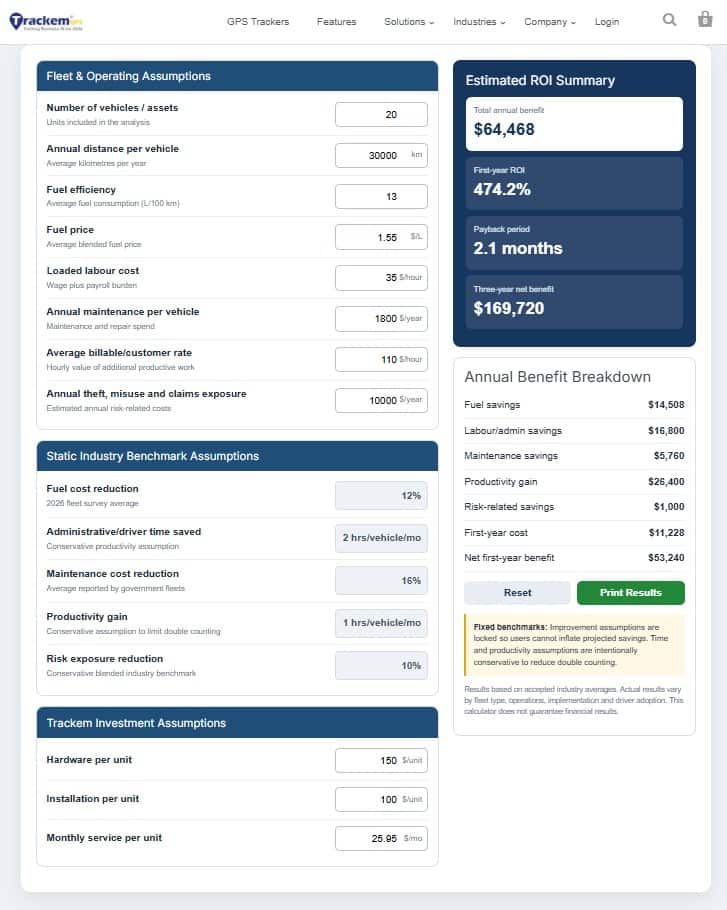
Try the Trackem GPS Fleet Tracking ROI Calculator.
Quick Answer
GPS fleet tracking costs depend on:
- The type of GPS hardware
- Number of vehicles or assets
- Software features required
- Reporting frequency (GPS ‘pings’)
- Installation requirements
- Fleet telematics capabilities
Rather than choosing the lowest-priced provider, businesses should compare total cost of ownership against the potential savings generated through improved efficiency.
What Does GPS Fleet Tracking Cost?
Every GPS fleet tracking solution includes three primary components:
- GPS tracking hardware
- Cloud software and cellular connectivity
- Installation (for hardwired devices)
Some providers bundle these costs into a monthly lease, while others allow customers to purchase hardware outright and pay only for ongoing service.
Businesses with smaller fleets often choose plug-and-play OBD-II trackers, while larger organizations typically deploy hardwired telematics devices for commercial vehicles and battery-powered GPS trackers for trailers, equipment and other valuable assets.
The best solution isn't necessarily the cheapest—it's the one that delivers the greatest long-term value.
What Affects GPS Tracking Pricing?
Several factors influence the overall cost of a GPS tracking system.
Hardware Type
Different businesses require different tracking devices.
OBD-II Trackers
Ideal for:
- HVAC companies
- Plumbing contractors
- Electricians
- Landscapers
- Delivery fleets
- Service businesses
Installation takes only a few minutes while providing GPS tracking, mileage reporting and engine diagnostics.
Hardwired GPS Trackers
Designed for:
- Commercial trucks
- Construction fleets
- Heavy equipment
- Municipal vehicles
- Utility fleets
Hardwired devices provide a more permanent installation along with expanded telematics capabilities.
Battery-Powered Asset Trackers
Ideal for:
- Trailers
- Heavy equipment
- Containers
- Generators
- Agricultural equipment
- Portable assets
Many modern asset trackers combine GPS, Wi-Fi positioning and cellular technology for reliable indoor and outdoor visibility.
Fleet Size
Larger fleets often qualify for volume pricing, customized reporting and dedicated account management.
The more vehicles and equipment your business has, the more GPS trackers need to be purchased, increasing the overall GPS fleet tracking cost upfront. For large diverse fleets, this may include trackers specific for passenger vehicles (OBDII Trackers), or for heavy equipment (hard-wired GPS trackers), or for trailers, tools and other non powered assets (asset trackers).
Each asset type in the fleet can demand custom GPS device scripting (ping rates). Some vehicles in the fleet may require location updates every 10 seconds, while a job box may only need to ping once per day.
Features Required
Additional features may include:
- AI dashcams
- Driver behaviour monitoring
- Fuel reporting
- Maintenance scheduling
- Driver scorecards
- Temperature monitoring
- PTO monitoring
- API integrations
- Indoor asset tracking
- Account management, monitoring, customization or integration
Choose features that solve real business problems rather than paying for functionality you'll never use.
GPS Tracking Hardware Options
| Device | Best For | Installation |
|---|---|---|
| OBD-II GPS Tracker | Service fleets & contractors | Plug-and-play |
| Hardwired GPS Tracker | Commercial vehicles & heavy equipment | Professional installation |
| Battery-Powered Asset Tracker | Trailers & equipment | No wiring required |
| Battery-Mounted GPS Tracker | Any asset with 6-48 V power source | Simple install direct to positive/negative |
Monthly Service Plans
Monthly subscriptions typically include:
- Cellular data and connectivity
- Cloud based GPS software platform access
- Mobile apps
- Reporting
- Mapping
- Alerts
- Software updates
- Customer support
When comparing providers, focus on overall value, not simply the monthly fee.
Reliable support, better reporting and stronger software often produce significantly greater savings than a lower monthly price.
Installation Costs
Installation depends on the hardware selected.
OBD-II Trackers
Plug directly into the vehicle's diagnostic port, located under the vehicles steering column. This can easily be done by most people, without any installation costs. Only if a y-cable is involved, to make the OBD tracker more covert, could the install be slightly more complex and time consuming.
Hardwired Trackers
Professionally installed behind the dashboard or inside heavy equipment. These trackers are generally wired directly into power, ground and ignition. They also have the ability to be wired in to monitor other functions such as power take offs (PTOs) and other inputs/outputs. These installations typically cost more and can take a technician 30 minutes to an hour per vehicle depending on the model and complexity of the installation.
Battery-Powered Asset Trackers
Typically mount in minutes with no wiring required. These can be installed with 2 screws, tie wraps, Velcro, double sided tape, or simply placed in a glove box. These installs have very little cost other than the hardware selected to do so.
Dashcam GPS Trackers
Dashcams can be a more involved installation. Every vehicle has a different windshield (where they are often mounted), with differing angles, which complicate the placement and set-up of the camera. These are hard wired in, however, they are visible and generally require wires to be routed under trim, to make for a neat and tidy look. Dashcams can be the most expensive GPS tracking and telematics hardware to install.
Hidden Costs to Watch For
Always ask potential suppliers about:
- Contract length
- Early cancellation fees
- Software licensing
- API charges
- Cellular overage fees
- Installation costs
- Replacement hardware
- Warranty coverage
- Customer support
The lowest monthly price doesn't always represent the lowest overall cost.
How Much Can GPS Tracking Save?
This is where the conversation changes.
Instead of asking:
"What does GPS fleet tracking cost?"
Ask:
"What is GPS tracking worth to my business?"
Organizations commonly reduce costs through:
- Lower fuel consumption
- Less idling
- Better route planning
- Reduced overtime
- Improved dispatching
- Fewer unauthorized trips
- Better preventative maintenance
- Less wear and tear
- Reduced accident-related expenses
- Less time theft
- Reducing after hours vehicle usage
- Optimal vehicle and asset utilization
Even modest improvements across these areas can produce a return on investment that pays for the system many times over and in short order. In fact, industry averages suggest that more often than not, your initial investment into GPS fleet tracking, will be paid off from efficiencies gained with 2 to 3 months.
Calculate Your Fleet ROI in Under Two Minutes
Don't Guess Your ROI
Every fleet is different.
Our free Trackem GPS Fleet Tracking ROI Calculator uses conservative industry benchmarks to estimate:
- Annual Fuel Savings
- Productivity Gain
- Maintenance Savings
- Risk Reduction Savings
- Total Annual Savings
- Annual ROI
- Payback Period
- Three-Year Financial Benefit
Simply enter a few details about your fleet and instantly see the potential financial impact and total GPS fleet tracking cost.
Try the Free Trackem GPS ROI Calculator or
Book a free demo with a Trackem rep to learn more.
FAQs
How much does GPS fleet tracking cost?
Pricing varies depending on the hardware, fleet size and features required. Most businesses purchase GPS hardware and pay an ongoing monthly software and connectivity subscription.
Is GPS tracking worth the investment?
In most cases, yes. Fuel savings, improved productivity, reduced maintenance costs and better fleet visibility often generate a positive return on investment within months.
Do I need fleet telematics or just GPS tracking?
If you only need to know vehicle locations, GPS tracking may be sufficient. Businesses looking to improve efficiency, reduce operating costs and monitor vehicle performance generally benefit from a more comprehensive telematics solution.
Can I install GPS trackers myself?
OBD-II devices typically install in minutes. Hardwired systems are usually installed by trained technicians, while battery-powered asset trackers require little or no wiring.
How can I calculate potential ROI regarding the purchase and installation for GPS tracking into my fleet?
Trackem offers a free Fleet Tracking and Telematics ROI Calculator for you to use for this exact purpose. Click here to give it a try.